Sunday, May 20, 2012

US forecasters say heat will stay on this summer


WASHINGTON (AP) — And the heat goes on. Forecasters predict toasty temperatures will stretch through the summer in the U.S. And that's a bad sign for wildfires in the West.
The forecast for June through August calls for warmer-than-normal weather for about three-quarters of the nation, theNational Oceanic Atmospheric Administration said Thursday.
The warmth is expected south of a line stretching from middle New Jersey to southern Idaho. Only tiny portions of northwestern U.S. and Alaska are predicted to be cooler than average and that's only for June, not the rest of the summer.

Last May until April was the hottest 12-month period on record for the nation with records going back to 1895. This year so far has seen the hottest March, the third warmest April and the fourth warmest January and February in U.S. weather history. And it was one of the least snowy years on record in the Lower 48.
Some people called it the year without winter.
And the outlook for summer is "more of the same," said Jon Gottschalck, head of forecast operations at NOAA's Climate Prediction Center in Camp Springs, Md. "There's definitely a tilt toward being above normal through the summer."
For some areas of the Southwest that could mean temperatures 1 or even 2 degrees warmer than normal on average, and maybe close to half a degree warmer than normal in the East, he said.
One of the reasons is that much of the country's soil is already unusually dry. So the sun doesn't use as much energy evaporating water in the soil and instead heats up the air near the ground even more, Gottschalck said.
Forecasters say the combination of the heat and dryness will only make western wildfiresworse. The fire season has already gotten off to a dramatic start. Wildfires in northern Arizona and northern Colorado forced residents to flee their homes on Thursday.
Fires in those areas could be even worse on Friday, said Greg Carbin, the meteorologist who coordinates warnings at the Storm Prediction Center in Norman, Okla.
"To see fires to the extent that they are this early isn't a good sign," he said. And the summer forecast is for "a pretty significant wildfire season developing across the western United States."

Google gets China OK for Motorola deal


NEW YORK (AP) — Authorities in China have approvedGoogle Inc.'s bid to buy phone maker Motorola Mobility, clearing the way for the $12.5 billion deal to close early next week.
But Chinese regulators attached a big condition: ThatGoogle's Android operating system for mobile devicesremain available to all at no cost for the next five years.

The approval brings the Internet search giant closer to sealing its biggest acquisition ever. Buying Motorola allows Google to expand into manufacturing phones, tablet computers and other consumer devices for the first time. The deal also gives Google access to more than 17,000 Motorola patents.
The Chinese government approved the deal on Saturday, Google spokeswoman Niki Fenwick said. "We look forward to closing the deal," she said.
The deal was announced last August and had received all necessary regulatory approvals except in China, where Google's government relations have been strained since it moved its search engine out of the country two years ago in a dispute over censorship and computer security.
Google's Android software powers more than 250 million mobile devices made by a variety of manufacturers, including Motorola Mobility. The latest versions must be made available free of charge for the next five years, apparently in response to concerns that competition could be hurt if Google gives updated versions to Motorola Mobility and withholds them from others. Google doesn't currently charge for Android.
Google earlier had pledged to make Android available to all its mobile partners. Even if Google were to discriminate, cellphone makers still could rely on mobile software fromMicrosoft Corp., Research in Motion and Hewlett-Packard Co., among others.
Google prizes Motorola Mobility Holdings Inc.'s patents as a crucial weapon in the intellectual arms race with Apple, Microsoft and other rivals maneuvering to gain more control over smartphones, tablets and other mobile devices.
Earlier, the U.S. Justice Department found no evidence that Google's ownership of Motorola Mobility would lessen competition in a mobile device market that is becoming increasingly important as more people connect to the Internet on smartphones and tablet computers instead of desktop and laptop computers.
The union with Motorola Mobility will open new opportunities and pose potentially troublesome challenges for a management team that so far has concentrated on Internet search, ad sales and other software-driven online services.
Motorola Mobility's expertise in mobile devices and set-top boxes for cable TV will allow Google to play an even more influential role in shaping the future of hand-held computing and home entertainment.
The $12.5 billion price paid by Google is more than the combined amount that Google has paid for the 185 other acquisitions that it has completed since going public in 2004.
Google is based in Mountain View, California, while Motorola Mobility has its headquarters in Libertyville, Illinois.

Alberto: Tropical storm watch on swath of SC coast


RALEIGH, N.C. (AP) — Tropical Storm Alberto swirled off theSouth Carolina coast packing maximum sustained winds of 50 mph (85 kph) on Sunday, a day after becoming the firsttropical storm of the 2012 hurricane season, the National Hurricane Center said.
The Miami-based center said Alberto was centered about 105 miles (170 kms) southeast of Charleston, S.C., at 2 a.m. EDT and moving toward the southwest near 6 mph (9 kph). It added that a tropical storm watch continued for South Carolina from the Savannah River to the South Santee River.

Forecasters have advised coastal interests from Georgia to North Carolina's Outer Banks to track the storm, citing the potential for dangerous surf.
The hurricane center issued its initial tropical storm watch for Albert on Saturday once the storm formed in the Atlantic. The official start to hurricane season is June 1, but tropical storms occasionally occur before then.
National Weather Service meteorologist Sandy LaCorte in Wilmington said projections on Saturday evening showed the storm was expected to turn to the northeast over the next several days.
She said the center of the storm was not expected to get close to the Carolinas' coast, though forecasters said dangerous surf conditions were possible along both the South Carolina and Georgia coasts. The storm also was about 145 miles (235 kilometers) east of Savannah, Ga., early Sunday.
LaCorte said Alberto was expected produce increased waves at beaches in the Carolinas. There also is a high risk of rip currents along North Carolina's Outer Banks, and a moderate risk along the southeastern beaches and the entire South Carolina coast.
The weather service also said isolated and scattered rain showers are expected along the coast of the Carolinas over coming days.
A forecast map by the hurricane center predicts that the storm would drift toward the open sea off the Mid-Atlantic region by midweek, but it's difficult to accurately predict a storm's path days in advance.
The 2 a.m. EDT Sunday advisory said Alberto, meanwhile, was expected to turn toward the west-northwest later in the day and then head to the north and northeast sometime Monday.
Little change in strength was forecast over the coming 48 hours, the center added, noting the maximum sustained winds were at 50 mph (85 kph) with higher gusts.
Forecasters added that tropical storm force winds extended about 45 miles (75 km) out from the center of Alberto.

Saturday, May 19, 2012

U.S. says will bar some Motorola Mobility phones


WASHINGTON (Reuters) - Some Motorola Mobilitysmartphones infringe on a Microsoft patent and will be barred from importation to the United States, a U.S. trade panel said on Friday.
The order by the U.S. International Trade Commission has been sent to President Barack Obama, who has 60 days to consider whether to overturn it for policy reasons.

The legal fight at the ITC is one of dozens globally between various smartphone makers. Google's Android system has become the top-selling smartphone operating system, ahead of mobile systems by Apple, Microsoft, Research in Motion and others.
On Wednesday, some of HTC's smartphone models were stopped at the U.S. border because it lost a patent dispute with Apple at the ITC in December. Shares in HTC tumbled more than 6 percent on news that shipments of the phones were being held up by U.S. customs.
The ITC order did not say which models of Motorola Mobility smartphone were affected but Microsoft has asked for the following devices to be stopped at the U.S. border: the Atrix, Backflip, Bravo, Charm, Cliq, Cliq 2, Cliq XT, Defy, Devour, Droid 2, Droid 2 Global, Droid Pro, Droid X, Droid X2, Flipout, Flipside, Spice and the Xoom tablet.
The patented technology at issue makes it possible for users to generate meeting requests and schedule gatherings using their mobile devices.
One option for Motorola Mobility will be to remove the meeting-scheduling technology from its smartphones and tablets. The company could also license it from Microsoft.
Motorola Mobility, which is in the process of being acquired by Google, said the company would not feel any near-term impact.
"Although we are disappointed by the commission's ruling that certain Motorola Mobility products violated one patent, we look forward to reading the full opinion to understand its reasoning," the company said in an emailed statement. "We will explore all options including appeal."
Both sides can appeal to the U.S. Court of Appeals for the Federal Circuit.
Microsoft said it was pleased with the decision. "We hope that now Motorola will be willing to join the vast majority of Android device makers selling phones in the US by taking a license to our patents," a company spokeswoman said via email.
In a complaint filed in October 2010 with the ITC, Microsoft accused Motorola Mobility of infringing nine patents for Windows Mobile and Windows Phone.
Two patents were dropped during litigation. An ITC administrative law judge in December found that Motorola Mobility infringed on one Microsoft patent in making Android cellphones but did not infringe on six others.
Google's Android software has recently become the most popular cellphone operating system with 56 percent of the market in the first quarter of 2012, according to data from Gartner Inc.
Motorola, which makes Android phones, is one of the smaller mobile phone makers with 8.4 million units sold globally in the last quarter, according to Gartner.
The ITC is a popular venue for patent litigation since it has the power to forbid the importation of products that infringe on patents.
The case at the ITC is No. 337-744.
(Reporting By Diane Bartz; Editing by Tim Dobbyn, Gary Hill)

Friday, May 18, 2012

Facebook's IPO one of world's largest


NEW YORK (AP) — Facebook found more than enough friends.
The world's definitive online social network said Thursday that it raised $16 billion for itself and its early investors in an initial public stock offering that values Facebook at $104 billion. That's more than Amazon.com and other well-known companies such as Kraft, Walt Disney and McDonald's.

It's a big windfall for a company that began eight years ago with no way to make money.
Facebook priced its IPO at $38 per share on Thursday, at the top of expectations. Now, regular investors will have a chance to buy stock in Facebook for the first time. The stock will begin trading on the Nasdaq Stock Market sometime Friday morning. The ticker symbol will be FB.
Facebook's offering is the culmination of a year's worth of Internet IPOs that began last May with LinkedIn Corp. Since then, a steady stream of startups focused on the social side of the Web has gone public, with varying degrees of success. It all led up to Facebook, the company that's come to define social networking by getting 900 million people around the world to share everything from photos of their pets to their deepest thoughts.
It has done so while managing to become one of the few profitable Internet companies to go public recently. It had net income of $205 million in the first three months of 2012, on revenue of $1.06 billion. In all of 2011, it earned $1 billion, up from $606 million a year earlier. That's a far cry from 2007, when it posted a net loss of $138 million and revenue of $153 million.
"They could have gone public in 2009 at a much lower price," said Nick Einhorn, research analyst at IPO investment advisory firm Renaissance Capital. "They waited as long as they could to go public, so it makes sense that it's a very large offering."
Facebook Inc.'s valuation is the third-highest in an IPO, according to Dealogic, a provider of financial data. Only two Chinese banks, Agricultural Bank of China in 2010 and Industrial and Commercial Bank of China in 2006, have been worth more. They were worth $133 billion and $132 billion, respectively. By another measure —the amount raised— Facebookranks third among U.S. IPOs. The largest was Visa, which raised $17.9 billion in 2008. No. 2 was Enel, a power company, and No. 4 was General Motors, according to Renaissance Capital.
The $38 share price is the price at which the investment banks arranging the offering will sell the stock to their clients. In an IPO, the banks buy the stock first from the company and the early investors and then sell to the public. If extra shares reserved to cover additional demand are sold as part of the transaction, Facebook and its early investors stand to reap as much as $18.4 billion.
For a company that was born in a Harvard dormitory and went on to reimagine online communication, the stock sale means more money to build on the features and services it offers users. It means an infusion of money to hire the best engineers to work at its sprawling Menlo Park, Calif., headquarters, or in New York City, where it opened an engineering office last year.
And it means early investors, who took a chance seeding the young social network with start-up funds six, seven and eight years ago, can reap big rewards. Peter Thiel, the venture capitalist who sits on Facebook's board of directors, invested $500,000 in the company in 2004. He's selling nearly 17 million of his shares in the IPO, which means he'll get some $640 million. He will hold on to about 28 million shares, worth $1.06 billion.
The offering values Facebook, whose 2011 revenue was $3.7 billion, at as much as $104 billion. The sky-high valuation has its skeptics, who worry about signs of a slowdown and Facebook's ability to grow in the mobile space when it was created with desktop computers in mind. Rival Google Inc., whose revenue stood at $38 billion last year, has a market capitalization of $207 billion.
"There seems to be somewhat of a hype around the stock offering," says Gartner analyst Brian Blau.
That may be an understatement.
Facebook's IPO dominated media coverage in the weeks and days leading up to the event. CEO Mark Zuckerberg's hoodie made headlines when he wore it to a meeting with investors as did General Motors' decision this week to stop advertising on the site —and rival Ford's affirmation that its Facebook ads have been effective.
There are more than a few reasons for the exuberance. First, there's Facebook's sheer size and high profile. The company grew from a college-only social network to an Internet phenomenon embraced by legions of people, from teenagers to grandmothers to pro-democracy activists in the Middle East.
Secondly, it's personal.
"It's probably one of the first times there has been an IPO where everyone sort of has a stake in the outcome," Blau says. While most Facebook users won't see a penny from the offering, they are all intimately familiar with the company.
And then there's Zuckerberg, who turned 28 on Monday. He has emerged as the latest in a lineage of Silicon Valley prodigies who are alternately hailed for pushing the world in new directions and reviled for overstepping their bounds. He counted the late Apple CEO Steve Jobs among his mentors, and he became one of the world's youngest billionaires — at least on paper — well before Facebook went public. A dramatized and less-than-flattering version of Facebook's founding was the subject of a Hollywood movie that won three Academy Awards last year, propelling Zuckerberg even further into the public spotlight.
Though Zuckerberg is selling about 30 million shares, he will remain Facebook's largest shareholder. Even after the IPO, he will own 503.6 million shares, or 32 percent of Facebook's total shares. At the $38 share price, his stake in the company is worth $19.1 billion. Zuckerberg will control the company with 56 percent of its voting stock as a result of agreements he has with other shareholders who promise to vote his way.
The set-up helps to ensure that he and other executives keep control as the demands of Wall Street for short-term returns exert new pressures on the company.
True to form, Zuckerberg and Facebook's engineers are ringing in the IPO on their own terms. The company is holding an overnight "hackathon" Thursday, where engineers stay up writing programming code to come up with new features for the site. On Friday morning, Zuckerberg will ring the Nasdaq opening bell from Facebook's headquarters a continent away.

Commercial rocket will fly to the space station


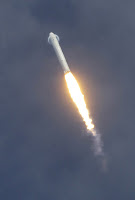
CAPE CANAVERAL, Fla. (AP) — For the first time, a private company will launch a rocket to the International Space Station, sending it on a grocery run this weekend that could be the shape of things to come for America's space program.
If this unmanned flight and others like it succeed, commercial spacecraft could be ferrying astronauts to the orbiting outpost within five years.
It's a transition that has been in the works since the middle of the last decade, when President George W. Bush decided to retire the space shuttle and devote more of NASA's energies to venturing deeper into space.

Saturday's flight by Space Exploration Technologies Corp. is "a thoroughly exciting moment in the history of spaceflight, but is just the beginning of a new way of doing business for NASA," said President Barack Obama's chief science adviser, John Holdren.
By handing off space station launches to private business, "NASA is freeing itself up to focus on exploring beyond low Earth orbit for the first time in 40 years."
California-based Space Exploration, or SpaceX, is the first of several companies hoping to take over the space stationdelivery business for the U.S. The company's billionaire mastermind, Elon Musk, puts the odds of success in his favor while acknowledging the chance for mishaps.
NASA likewise cautions: This is only a test.
"We need to be careful not to assume that the success or failure of commercial spaceflight is going to hang in the balance of this single flight," said Mike Suffredini, NASA's space station program manager. "Demo flights don't always go as planned."
Once it nears the space station after a two-day flight, the SpaceX capsule, called Dragon, will spend a day of practice maneuvers before NASA signals it to move in for a linkup. Then its cargo — a half-ton of food and other pantry items, all nonessential, in case the flight goes awry — will be unloaded.
Up to now, flights to the space station have always been a government-only affair.
Until their retirement last summer, shuttles carried most of the gear and many of the astronauts to the orbiting outpost. Since then, American astronauts have had to rely on Russian capsules for rides. European, Japanese and Russian supply ships have been delivering cargo.
It will be at least four to five years before SpaceX or any other private operator is capable of flying astronauts. That gap infuriates many. Some members of Congress want to cut government funding to the private space venture and reduce the number of rival companies to save money and speed things up.
The shift to private enterprise, while revolutionary in space, has a long history in the U.S. The Internet, for example, evolved from government work. Space station astronaut Donald Pettit points to the settling of the American West: The government ran the forts, and private enterprise built the railroads.
In this instance, NASA employees are still working closely with the commercial contenders, giving advice and attending company meetings.
"I see this whole story repeating itself again and again as we move from low-Earth orbit," Pettit said. "And it will probably repeat itself when we go to the moon and elsewhere."
No one is rooting more for SpaceX than NASA. The space agency has poured $381 million into the SpaceX effort, while the company has spent $1 billion over its 10-year lifetime, said Musk, the high-tech pioneer who co-founded PayPal and Tesla Motors, the electric car company.
NASA also gave $266 million to a second company it hired to make supply runs. Virginia-based Orbital Sciences Corp. hopes to launch its Antares rocket and Cygnus capsule from Wallops Island, Va., by year's end.
"This is the start of a real new era," said Dutch spaceman Andre Kuipers, who will help Pettit snare the Dragon and pull it to the space station with a robotic arm.
Pettit agreed the upcoming Dragon flight is a "big deal," but added: "I hope this becomes so routine that people won't even pay attention to it anymore."
SpaceX will have only a split second, at 4:55 a.m. Saturday, to shoot its Falcon rocket and Dragon capsule skyward. (All spacecraft bound for the space station these days have instantaneous launch windows in order to sync up efficiently with the orbiting outpost.)
SpaceX already has achieved what no other commercial entity has done: It launched a spacecraft into orbit and brought it back intact in a 2010 test flight that ended with the capsule splashing down in the Pacific.
But getting to the space station is twice as hard, said Musk, who is not only CEO but chief designer. A Dragon capsule has never before attempted a rendezvous and docking in orbit — an exquisitely delicate operation, with the risk of a collision that could prove ruinous for the space station, which has six men on board.
If something goes wrong, "we'll fix the problem and be back at it," Musk said. Two more SpaceX delivery trips are planned for this year.
The bell-shaped Dragon capsule is 19 feet tall and 12 feet across. What sets it apart from other capsules is that it can bring back space station experiments and old equipment, as the shuttles did. None of the Russian, European and Japanese supply ships do that — they burn up when they return to Earth. The Russian Soyuz vehicles that ferry astronauts have little room to spare.
The Dragon will be cut loose from the space station about two weeks after arriving and aim for a Pacific splashdown off the California coast.
Other U.S. companies vying for a shot at launching space station astronauts — like Sierra Nevada Corp., which is designing the mini-shuttle Dream Chaser — are cheering on SpaceX since it is the first one out of NASA's post-shuttle, commercial gate.
Former space shuttle commander Steven Lindsey, director of flight operations for Sierra Nevada in Colorado, said: "It's a new way of doing business, and there's a lot of debate back and forth on whether it's going to be successful — or whether it can be successful."
___
Online:
SpaceX: http://www.spacex.com
NASA: http://www.nasa.gov/offices/c3po/home/
Sierra Nevada Corp.: http://sncspace.com/space_exploration.php

'Ring of Fire' eclipse visible from China to Texas


LOS ANGELES (AP) — Sunrises and sunsets often dazzle, but they'll have a special ring to them in a few days for people in the western United States and eastern Asia: The moon will slide across the sun, blocking everything but a blazing halo of light.

It's been almost two decades since a "ring of fire" eclipse was visible in the continental United States. To celebrate the end of that drought, nearly three dozen national parks in the path of the eclipse will host viewing parties.
The solar spectacle is first seen in eastern Asia at dawn Monday, local time. Weather permitting, millions of early risers in southern China, northern Taiwan and southeast Japanwill be able to catch the ring eclipse. Then it creeps across the Pacific with the western U.S. viewing the tail end.
The late day sun will transform into a glowing ring in southwest Oregon, Northern California, central Nevada, southern Utah, northern Arizona and New Mexico and finally the Texas Panhandle where it will occur at sunset on Sunday. For 3 ½ hours, the eclipse follows an 8,500-mile path. Viewing, from beginning to end, lasts about two hours. The ring phenomenon lasts as long as 5 minutes depending on location.
Outside this narrow band, parts of the West, Midwest and South — and portions of Canada and Mexico — will be treated to a partial eclipse. The Eastern Seaboard will be shut out, but people can log online to sites such as the Slooh Space Camera, which plans to broadcast the event live.
A ring eclipse — technically called an annular solar eclipse — is not as dramatic as a total eclipse, when the disk of the sun is entirely blocked by the moon. As in a total solar eclipse, the moon crosses in front of the sun, but the moon is too far from Earth and appears too small in the sky to blot out the sun completely.
"A bright ring around the sun at mid-eclipse is still pretty cool," Geoff Chester of the U.S. Naval Observatory said in an email.
Asia is abuzz over the event. In Japan, cable cars will run early to give tourists an unobstructed view from the mountains. Ferries will make special trips so that others can enjoy the scene offshore. The Taipei Astronomical Museum will open its doors at dawn while Hong Kong's Space Museum will set up solar-filtered telescopes outside its building on the Kowloon waterfront.
The last time this type of eclipse was seen in the U.S. was in 1994. This year's solar show offers ringside seats at 33 national parks along the eclipse path including the Grand Canyon and Bryce Canyon. A partial eclipse can be viewed from another 125 national parks.
For die-hard sky gazers, six U.S. locations will see the moon cover about 95 percent of the sun's diameter. They include the Petroglyph National Monument, Redwoods National Park, Lassen Volcanic National Park, Canyon de Chelly National Monument, Zion National Park and Glen Canyon National Recreation Area.
Wherever you are, do not look directly at the eclipsed sun or you can get a serious eye injury. Wear specially made protective glasses that can be bought online or create your own contraption by punching a small pinhole in a cardboard box.
If you buy special eyewear, you can recycle it. Two weeks later, Venus will crawl across the face of the sun — a rare occurrence known as the "transit of Venus" that will also require viewers to take precaution.
Veteran eclipse chaser Jay Pasachoff has traveled to remote corners of the globe to see the moon take a bite of the sun. This time, the Williams College astronomer will travel to New Mexico with his students to collect data.
Sunday's event will be his 14th ring eclipse and 55th solar eclipse overall. So what does someone who has seen it all look forward to?
Seeing "the symmetry of a ring of sunlight around the dark silhouette of the moon," Pasachoff said in an email.
The next ring eclipse won't be visible in the U.S. for more than a decade — October 2023.
___
AP writers Eric Talmadge in Japan, Peter Enav in Taiwan and Kelvin Chan in Hong Kong contributed to this report.

Exclusive: U.N. probes possible North Korea arms trade with Syria, Myanmar


UNITED NATIONS (Reuters) - A U.N. panel of experts that monitors compliance with sanctions on North Korea is investigating reports of possible weapons-related deals between Pyongyang and Syria and Myanmar, the panel said in a confidential report seen by Reuters on Thursday.
"The DPRK (North Korea) continues actively to defy the measures in the (U.N. sanctions) resolutions," the panel said in the report, which it submitted to the U.N. Security Council's North Korea sanctions committee earlier this week.

"Member states did not report to the committee any violations involving transfer of nuclear, other (weapons of mass-destruction)-related or ballistic missile items," it said. "But they did report several other violations including illicit sales of arms and related materiel and luxury goods."
U.N. panel of experts' sanctions reports are highly sensitive. China, which is named in the report as a transit hub for illicit North Korean arms-related breaches, has prevented the 15-nation Security Council from publishing past reports and may do so with the latest one, U.N. envoys have told Reuters.
"Although the (sanctions) have not caused the DPRK to halt its banned activities, they appear to have slowed them and made illicit transactions significantly more difficult and expensive," the panel's report said.
One of the cases involving suspected illicit arms trade with Syria was reported to the council's sanctions committee last month.
"In April 2012, France reported to the committee that it had inspected and seized in November 2010 an illicit shipment of arms-related materiel originating from the DPRK and destined for Syria," the report said.
The shipment, which was on board the ship M/V San Francisco Bridge, was said to be containing "copper bars and plates."
"However, France's inspection of the cargo revealed that it contained brass discs and copper rods used to manufacture artillery munitions (pellets and rods for crimping cartridges and driving bands) and aluminum alloy tubes usable for making rockets," the panel said.
Another case cited in the report involved a 2007 shipment of propellant usable for SCUD missiles and other items that could be used for ballistic missiles. The panel had referred to it in last year's report but added details about a Syria connection and confirmed that it had been transported via China.
"This shipment originated in the DPRK, was trans-shipped in Dalian (China), and Port Kelang (Malaysia), and transited through other ports," the report said. "It was en route to Latakia, Syria."
Although both shipments mentioned in the report were made before the Syrian government launched its assault on opposition demonstrators in March 2011, diplomats said they were worrying because it showed the kinds of items Damascus had been trying to add to its arsenal - and the aid it received from North Korea and China.
The panel said it could not prove North Korea continued to maintain ballistic missile cooperation with Iran, Syria and other countries, "but notes that it would be consistent with reports of the DPRK's long history of missile cooperation with these countries and with the panel's observations."
WEAPONS COOPERATION WITH MYANMAR?
Ten thousand rolls of tobacco, 12 bottles of Sake, and some second-hand Mercedes Benz cars are among the latest reported breaches by North Korea of the luxury goods ban.
The panel said it was looking at the possibility North Korea has a deal with Myanmar on conventional weapons cooperation in violation of Security Council sanctions passed in 2006 and 2009 after Pyongyang's nuclear test in those years.
The report said the panel took note of statements by the new president of the former Burma that Myanmar does not "have nuclear or weapons cooperation with the DPRK."
There have been media reports that Myanmar's previously ruling generals, who recently ceded power to a civilian-led government, had been exploring nuclear-weapons cooperation with North Korea. Myanmar has always denied such reports.
The panel said it took note of those denials but expressed concern about the possibility of "other prohibited cooperation" between Myanmar and North Korea.
It referred to a recent statement by the speaker of Myanmar's new parliament, Thura Shwe Mann, who, according to the panel, announced he had signed a memorandum of understanding with Pyongyang during a 2008 visit to North Korea.
"It was not on nuclear cooperation as is being alleged," the panel quoted the speaker as saying. "We studied their air defense system, weapons factories, aircraft and ships. Their armed forces are quite strong, so we just agreed to cooperate with them if necessary."
The panel said Shwe Mann may have visited a ballistic missile factory in North Korea and added that it was concerned the memorandum of understanding violated U.N. sanctions, which forbid North Korea from selling arms and related technology as well as from buying or selling nuclear and missile technology.
The United States and its allies are worried that North Korea is planning a third nuclear test after its recent failed missile launch. They are also concerned that Pyongyang is expanding its uranium enrichment program in addition to its plutonium reprocessing work that has yielded atom bomb fuel.
High-grade enriched uranium, like plutonium, can be used as fuel for a nuclear weapon.
But the U.N. panel said it had seen no evidence that North Korea had been attempting to import banned items like maraging steel and high-strength aluminum tubes, which it would need to expand its enrichment centrifuge program.
"Since May 2011, no attempts by the DPRK to import these have been reported to the committee or brought to the attention of the panel," the report said.
"It remains unclear whether this is because the DPRK has succeeded in doing so undetected, or stockpiled these items before sanctions were introduced, or is not after all trying to procure them," the panel said.
The panel said it did not agree with suggestions that North Korea could produce high-strength maraging steel, adding that even if it could do so, it would likely not be able to produce it with the quality needed for enrichment centrifuges.
The panel also took U.N. member states to task for lax application of the punitive measures, saying "overall implementation of the sanctions leaves much to be desired."
(Reporting By Louis Charbonneau and Michelle Nichols; Editing by Peter Cooney)

Verizon data fans to pay more in service or phones


NEW YORK (Reuters) - Verizon Wireless plans to make its data-hungry customers pay a lot more, either in service fees or smartphone prices, as it tries to cut costs and boost revenue from data services.
The No. 1 U.S. mobile provider said it will eliminate unlimited data plans for all customers who upgrade their cellphone at a discounted rate, potentially driving more business to its smaller rival Sprint Nextel .

Only customers who pay full price for their cellphones will be able to keep unlimited data service plans for a flat monthly fee of $30 a month.
Spokeswoman Brenda Raney explained the new policy a day after a top company told an investor conference that customers moving to Verizon's high-speed network would have to give up their unlimited data plans.
To convince customers to sign a 2-year contract, Verizon typically shoulders some of the cost of their smartphone in the form of a subsidy it pays to the handset vendor. Today customers who want to keep their unlimited data plan can still get the handset discount.
But when the company kicks off a new shared data plan this summer, any customers upgrading to a discounted handset will have to change from an unlimited plan to a shared data plan whose fees increase with data usage.
This will affect customers on both Verizon's older third generation network and those on its fastest fourth generation service, according to Raney.
Customers will be able to keep their unlimited plan as long as they stick with the same smartphone. But when that phone gets too old, the only customers who will be able to keep their unlimited plan are those who pay the full retail handset price.
This would mean a price increase of several hundreds of dollars for high end smartphones.
For example, the full price of the cheapest Apple Inc iPhone 4G is $650, compared with the $200 price for customers who take the discount. The full price for the Motorola Mobility Droid 4 phone is $550 versus $200 for customers who take the discount.
The shared data plans will allow customers to sign up for a single plan covering more than one gadget, including smartphones and tablet computers.
Verizon Wireless, a venture of Verizon Communications Vodafone Group Plc , has declined to provide any additional details about its shared data plans.
Under today's pricing Verizon Wireless customers without unlimited plans pay $30 a month for 2 gigabytes of data, $50 for 5 gigabytes and $80 for 10 gigabytes. If they use more than their allowance they are charged at higher rate.
Smaller rival AT&T Inc said it also wants to offer a shared data plan. No. 3 U.S. mobile provider Sprint still offers unlimited data plans.
Analysts have said that wireless operators needed to introduce shared plans if they are to convince consumers to connect devices like tablets to the cellular network.
(Reporting by Sinead Carew; Editing by Richard Chang)

Thursday, May 17, 2012

Three-man Soyuz crew departs for space station


ALMATY, Kazakhstan (AP) — A three-man crew blasted off from a space center in southern Kazakhstan Tuesday morning on board a Russian-made Soyuz craft for a four-and-half-month stay at the International Space Station.
NASA astronaut Joseph Acaba and Russian cosmonautsGennady Padalka and Sergei Revin set off from the Baikonur facility as scheduled at 9:01 a.m. local time (0301 GMT).

Russia's space agency says the craft is due to dock with thespace station Thursday morning Moscow time and will join the three astronauts currently staying at the orbiting laboratory.
The crew, which is being commanded by retired 53-year old Russian Air Force Col. Padalka, will immediately get to work preparing for the arrival next week of privately owned SpaceX's Dragon Capsule. It will be the first time a private company has launched space station supplies.
The space station is currently occupied by Russian cosmonaut Oleg Kononenko, NASA astronaut Don Pettit and Holland's Andre Kuipers.
Padalka is a seasoned space traveler, having spent a total of 585 days in space on three previous missions on board the now-defunct Mir station and the current International Space Station. Inglewood, California-native Acaba, who turns 45 on Thursday, on the day that Soyuz is due to dock, makes his second venture into space after his maiden orbital voyage on the shuttle in 2009. Revin, 46, is making his first trip to space.
Until NASA either brings a new craft online or private companies are able to arrange manned trips to the orbiting station, the Soviet-designed Soyuz spacecraft will remain the only means to deliver crews to the orbiting outpost.
The Russian space program has been blighted by a string of technical glitches in the recent past, raising questions over its dependability.
Tuesday's launch had been pushed back by two months due to depressurization of the spacecraft's descent module during the ground testing phase. It was the second significant postponement of a manned Russian launch in the space of a year.
A Russian Mars moon probe crashed to Earth in January in what the nation's space agency described as the result of cosmic radiation.
That came only weeks after the crash of a communications satellite and the crash in August of a supply ship destined for the space station.

LG announces Optimus UI for Ice Cream Sandwich devices

LG on Wednesday announced a new user-interface skin for its Android-powered devices running Ice Cream Sandwich. The South Korean company's Optimus UI 3.0 is said to be designed with convenience and speed in mind, and is being labeled as both unobtrusive and simple. "With smartphone hardware becoming more and more similar, it's important for manufacturers to differentiate their products from the competition through the user interface," said Dr. Jong-seok Park, President and CEO of LG Electronics Mobile Communications Company. "Both
carriers and customers tell us that they want LG phones to look and feel unique and the UI plays a big part in that. LG is really going to push the boundaries of what is possible in user interfaces starting with Optimus UI 3.0." The new UI will allows users to drag anywhere to unlock the screen, and will feature an an Icon Customizer, revamped Pattern Lock and a Voice Shutter feature to allow photos to be taken with voice commands. The Optimus UI 3.0 will debut next week with the launch of LG's Optimus LTE II in Korea. LG's press release follows below.
LG'S NEW OPTIMUS UI 3.0 ADDS NEW FEATURES AND FUNCTIONS WHILE BEING UNOBTRUSIVE AND SIMPLE
New User Interface Makes the LG Smartphone Experience Faster, Simpler, More Convenient
SEOUL, May 16, 2012 – LG Electronics (LG) is introducing a new User Interface (UI) for its newest Android Ice Cream Sandwich devices, aptly named Optimus UI 3.0. Optimus UI 3.0 brings with it an array of enhanced key features, including Quick Memo™ and unique unlock functions, among other new features and functions aimed at improving LG smartphone experience.
"With smartphone hardware becoming more and more similar, it's important for manufacturers to differentiate their products from the competition through the user interface," said Dr. Jong-seok Park, President and CEO of LG Electronics Mobile Communications Company. "Both carriers and customers tell us that they want LG phones to look and feel unique and the UI plays a big part in that. LG is really going to push the boundaries of what is possible in user interfaces starting with Optimus UI 3.0."
Optimus UI 3.0 is designed with convenience and speed in mind. A powerful memo function called Quick Memo™ enables users to jot notes on the screen using a finger. Quick Memo™ in Optimus UI 3.0 allows users to share their thoughts through social networks, text messages and e-mails more conveniently than ever before.
Other new features include:
– the ability to unlock the phone by dragging anywhere on the screen;
– a new Pattern Lock that allows users to preset the most frequently used function, such as the camera, which automatically opens once the phone is unlocked;
– a simpler version of Optimus UI 3.0 for new smartphone users which organizes the main applications so that they are the easiest to access;
– a new Voice Shutter that allows users to capture photos using only voice commands;
– a special camera feature that enables users to pick up the best shot among multiple images including the moment just before the shutter button is depressed;
– an Icon Customizer that provides an additional level of personalization by allowing users to set their own photos as icons and shortcut images;
– the addition of a Download category to the menu for easier organization.
Optimus UI 3.0 will debut on the LG Optimus LTE II launching this week in Korea, followed by LG Optimus 4X HD in June.